Other news
LOGYCO: the new Palazzoli floodlight in ECOTHERM, delivering up to 165 lm/W and weighing less than 2 kg
Reducing energy consumption is not simply a matter of replacing a traditional system with LED luminaires. The real leap forward is achieved by integrating lighting with smart control systems, capable of adapting the system’s operation to actual operational needs.
This is the approach adopted by Palazzoli, which develops comprehensive solutions in which high-efficiency LED luminaires and advanced management systems work together to maximise energy savings, improve operational continuity and reduce running costs.
How to achieve maximum savings
Presence sensors, natural light sensors, timers and centralised management via a cloud platform allow the luminous flux to be switched on, off and dimmed only when and to the extent that it is actually needed.
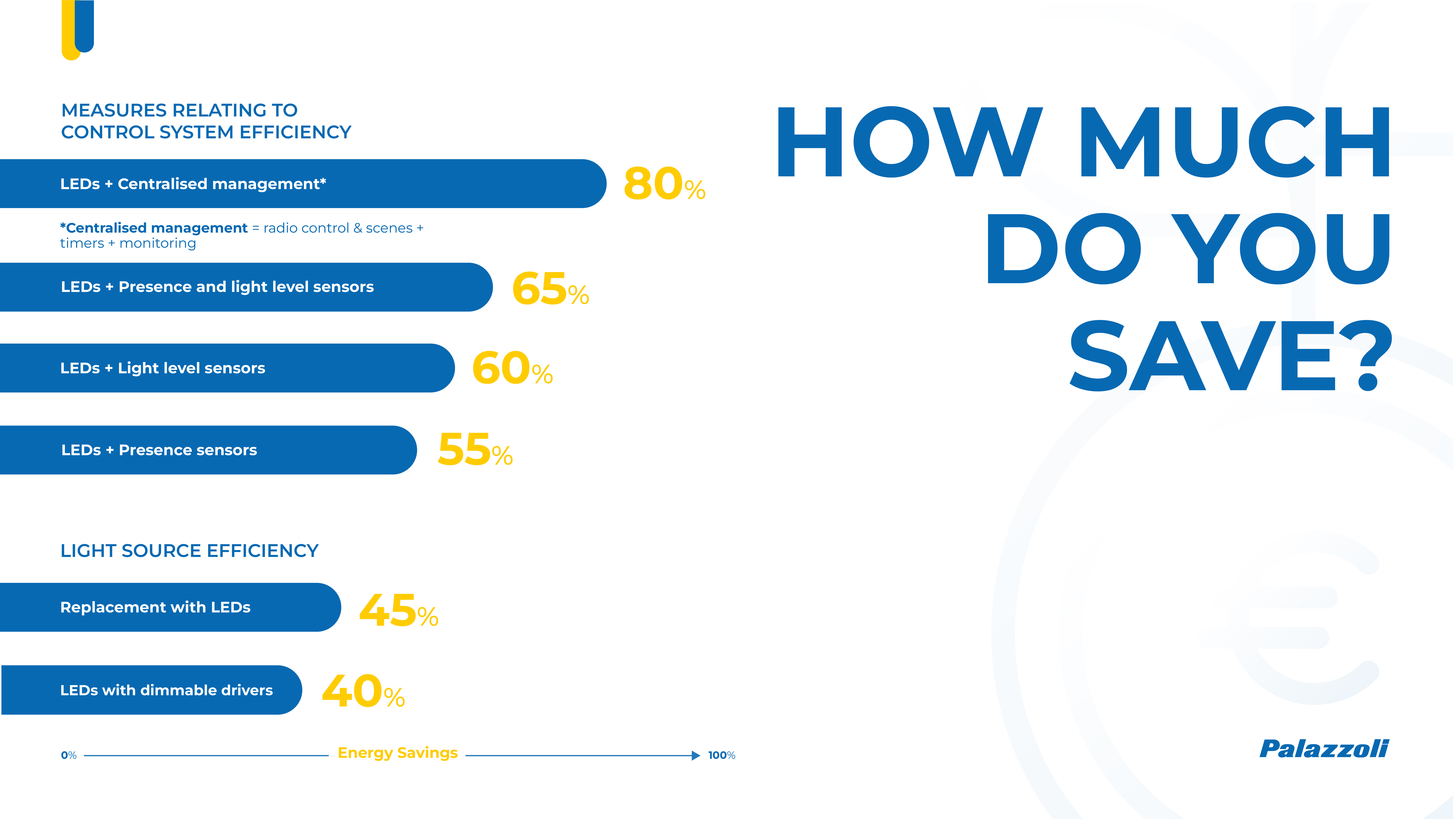
According to the LENI method set out in UNI EN 15193-1, the integration of LED technology with control systems can reduce energy consumption by up to 80% compared with a traditional fluorescent system, depending on room occupancy and the contribution of natural light.
Not just energy: lower costs, greater efficiency
Smart lighting delivers benefits that go beyond the electricity bill. Remote control allows you to:
The result is a system that is more efficient, reliable and easier to manage throughout its entire lifecycle, with a Total Cost of Ownership (TCO) that is generally lower than that of a traditional solution.
A practical example
Let’s consider a building with a T8 fluorescent lighting system that consumes 100 MWh/year.
| Configuration | Annual consumption | Savings |
| Fluorescent lighting system | 100 MWh | 0 |
| Conversion to LED | 60 MWh | -40% |
| LED + presence sensors and natural light | 35 MWh | -65% |
|
LED + Wireless control and cloud management |
20 MWh |
-80% |
From theory to practice: Palazzoli’s solutions
To achieve these results, the system must be designed as an integrated whole, in which luminaires and the control system communicate with one another.
Palazzoli offers both technologies:
Conclusion
Maximum energy savings do not depend solely on the efficiency of the luminaires, but on the ability of the entire system to provide light only when, where and in the quantity that is actually required.
This is the principle behind smart lighting: integrating LED technology and control systems to transform energy savings into a tangible, measurable and lasting result.
Would you like to assess the savings potential of your lighting system? Contact your local Palazzoli representative or email export@palazzoli.it.